Thursday, March 14, 2013

Kitty Murderers

Every cat is a little hunter at heart. Even Samwise, with his lazy sleep-all-day attitude occasionally gets "the rips" and runs around the house wanting to play and attack his little, toy goldfish.

Finny: "I want to play with the goldfish too..."

In a study done by the University of Georgia, it has been discovered that cats spend most of their nights hunting down small animals. This will be no surprise to people who own cats. Cats love to hunt down and play with little creatures like birds, rodents, and lizards.

The study was done by using kitty cams, small cameras attached to the cats' collars. The cameras recorded everything from the cats' point of view and showed researchers what exactly it is cats like to do all night. This is how they figured out that cats like to kill--a lot!

What is fascinating is that cats don't kill because they are hungry. In fact, the cats only ate 30 percent of the animals they killed, brought home 21 percent, and left the rest of their victims to rot on the ground. Cats kill things because they play them to death. Literally.

Cats also make an average of 2.1 kills per week, which adds up fast considering that there are 86.4 million house cats in America alone, and that doesn't include strays.

Male cats have proven to be more avid hunters than female cats, UGA also discovered. Finny agrees with this statement.

"I'm a great adventurer!"

If you are interested in viewing any of the kitty cam footage, you can do so at their website.

~RL

Thursday, February 21, 2013

The Anniversary: A Cat Success Story

In two days, my husband and I will be celebrating our "seventhmonthivesary," which is our way of saying "We've been married for seven months, so we're going to celebrate!"


I've been threatened by our family members, who grow tired of our monthly celebrations, that once we hit the one year anniversary, we'll have to stop our monthiversaries, and I'm sure we will. It's just been so exciting to celebrate every small step we make together as a couple.

Married couples aren't the only ones to celebrate anniversaries--cats have anniversaries as well, especially Emma, a library cat.

Picture from thelymes.patch.com.

This year on February 4, Emma celebrated her 10th anniversary at Lyme Public Library in Connecticut.   In 2003, Emma arrived at the library and instantly became part of the family. Her previous home had been the local animal shelter, so on her anniversary the library accepted gifts of cat and dog food, toys, and other pet supplies to be donated to the shelter for other pets like Emma who were without a home.

An article on The Lymes Patch about Emma says that she has had country-wide visitors. She's also been featured in Cat Fancy magazine, the book Working Cats of Southern New England, and has her own page on Lyme Public Library's website. Emma also has a twitter you can follow.

In August, Finny will have been with me for two years, and this October, Finnegan will celebrate the first anniversary of his blog. He looks forward to celebrating these anniversaries with you!

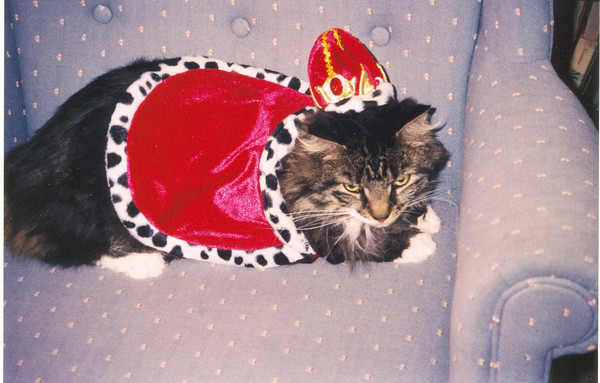
This is my party outfit!

~RJL

Wednesday, January 30, 2013

More Pets, Please!

Cats love to be petted--no one will argue with that. The question is . . . why do they like it?

"More pets, please!"

AvoDerm, a premium cat and dog food company, hosts a page on their website called "Why Do Cats Do that?" which attempts to explain many of cat's behaviors. One of the questions they answer is our question of the day: why do cats like to be petted? Their answer is fairly simple: "To your cat, petting feels a lot like licking. when you pet your cat slowly and gently, she knows you are taking good care of her. You are showing that you love her!"

Mother cats lick their kittens to clean them. kittens grow up associating the sensation of being groomed with their mother's tender care. When you pet your cat, you are giving them that same motherly love. This is why cats purr when they are being petted--they know that you care about them and it makes them happy.

Gently pet your cats often--let them know just how much you love them.

"Why did you stop petting me?"

~RL

Monday, January 21, 2013

Feeling a Little Pukey


This past week, Finnegan was feeling very sick. For about three days, he couldn't keep food down; he vomited multiple times throughout the day. I wasn't sure what was making him sick, and was considering taking him to the vet.

He moped around the house, wanting to be held for extended periods of time, and slept nearly all day. By looking at his face, I could tell that he just didn't feel well at all.


Cats get sick for many different reasons. Pets.webmd.com talks about some of the causes and treatments for cats when they vomit. The most common reason that cats get sick is because they swallowed something that irritated their stomachs, like hair, grass, or bad food.

Webmd explains that it is normal for cats to vomit a time or two if they eat something that makes them sick. The site also warns cat-owners to take their pet to the vet if it vomits for more than a few days or too many times in a row.

You can oftentimes tell what is wrong with your cat by determining the way your cat is vomiting. Webmd identifies five different types of vomiting to watch out for in cats because they can indicate a more serious problem.

A type indicated with a * means that if your cat presents this sort of vomiting, get your cat checked out immediately by a veterinarian.

1. Persistent vomiting: Suggests the consumption of indigestible substances such as grass, hairballs, or spoiled food. Could also be a sign of infectious enteritis.

2. Sporadic vomiting*: Has no relationship to meals and leaves the cat looking haggard and listless. Suggests liver or kidney disease, worms, digestive track diseases, or (in older cats) an intestinal tumor. 

3. Vomiting blood*: Indicates bleeding between the mouth and small intestines.

4. Vomiting feces*: Suggests an intestinal obstruction or peritonitis

5. Projectile vomiting*: Suggests a complete blockage in the upper gastrointestinal tract that might be caused by hairballs, tumors, or small objects. Brain diseases such as a tumor, encephalitis, and blood clots, also can be an indication.

If you ever have a question about the severity of your cat's vomiting, always seek help from a vet. Vomiting can also quickly lead to your cat becoming dehydrated, which is also a serious problem. 

Webmd also explains how to treat your cat at home for normal vomiting. If your cat is only vomiting and does not show signs of any other serious problem, you can easily treat it at home. After the object that is bothering your cat's stomach is expelled, it is best to withhold food for a few hours to allow the stomach to rest. If your cat is thirsty, you can give it some ice cubes to lick initially and then a few sips of water after its stomach has had time to rest. If the vomiting has stopped after a few hours and water is being tolerated well, you can offer some food to your cat. 


Thankfully, Finnegan's little stomach bug passed and he suddenly got better yesterday. He feels a lot better now and is back to being his silly, wild, lovable self.

~RL